ISLAMABAD, (UrduPoint / Pakistan Point News - 12th Jul, 2020 ) :MPA Pakistan Tehreek-e-Insaf Sardar Mahinder Pal Singh Sunday said that prime minister Imran Khan's government was implementing the vision of Quaid-e-Azam Muhammad Ali Jinnah for protecting the rights of…
Islamabad [Pakistan], July 12 (ANI): Ever since work on Islamabad's first Hindu temple began earlier this month, many Pakistanis have been on a spree threatening their government of violence and…
Introduction India has received a large number of refugees from neighbouring countries such as Sri Lanka, Bangladesh, Afghanistan, etc., but it does not have a clear legal structure to govern…
Spokesperson in the Ministry of External Affairs Anurag Srivastava said the issue figured during recent telephonic conversation between foreign ministers of the two countries. India on Thursday said it was…
The head of the Human Resources Development Committee MP Khalil Al-Saleh called on the government to comply with its promises and submit the report on addressing the imbalance in the…
A proposed bill which aims to reduce the Kuwait's expat community by 40 percent may come into effect later this year. The decision comes amid the coronavirus pandemic and a…
A group of 58 Indian-origin executives heading various companies across 11 different countries, including the US, Canada and Singapore, collectively employ more than 3.6 million people and account for a…
https://youtu.be/jda-KujNTFQ A total of eight lakh Indians could be forced to leave Kuwait as its National Assembly committee has approved a draft expat quota bill seeking to reduce the number…
Refugees are people who have fled war, violence, conflict or persecution and have crossed an international border to find safety in another country.
They often have had to flee with little more than the clothes on their back, leaving behind homes, possessions, jobs and loved ones.
Refugees are defined and protected in international law. The 1951 Refugee Convention is a key legal document and defines a refugee as:
“someone who is unable or unwilling to return to their country of origin owing to a well-founded fear of being persecuted for reasons of race, religion, nationality, membership of a particular social group, or political opinion.”
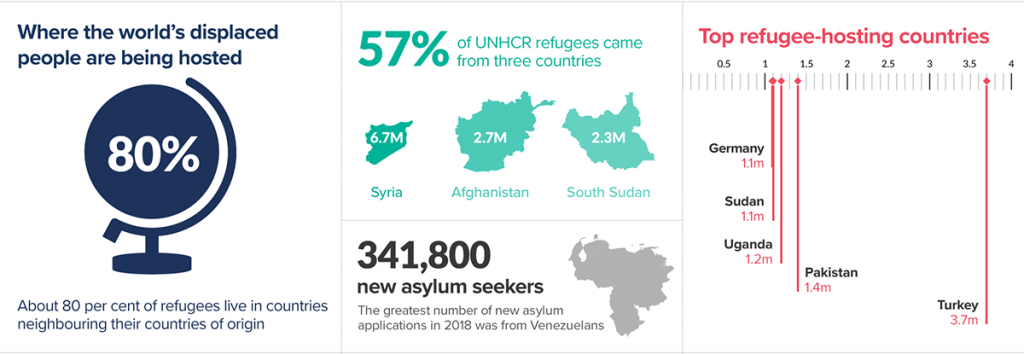
By the end of 2017, there were 25.4 million refugee men, women and children registered across the world.

In the 1960s, the decolonization of Africa produced the first of that continent's numerous refugee crises needing UNHCR intervention. Over the following two decades, UNHCR had to help with displacement crises in Asia and Latin America. By the end of the century there were fresh refugee problems in Africa and, turning full circle, new waves of refugees in Europe from the series of wars in the Balkans.
In a world where nearly 1 person is forcibly displaced every 2 seconds as a result of conflict or persecution, the work of UNHCR is more important than ever before.
Descendants of refugees retain refugee status
Under international law and the principle of family unity, the children of refugees and their descendants are also considered refugees until a durable solution is found. Both UNRWA and UNHCR recognize descendants as refugees on this basis, a practice that has been widely accepted by the international community, including both donors and refugee hosting countries.
Palestine refugees are not distinct from other protracted refugee situations such as those from Afghanistan or Somalia, where there are multiple generations of refugees, considered by UNHCR as refugees and supported as such. Protracted refugee situations are the result of the failure to find political solutions to their underlying political crises.